Last week I attended a presentation at the local university on sea level rise and the potential effect on the local landscape. The speakers showed various projections of what might happen to the university itself under different scenarios.
I happen to live near the university campus, about three miles from the auditorium where the presentation took place. It’s one thing to contemplate sea level rise that might be happening somewhere else; it’s quite another to watch as a panel of scientists projects a series of maps showing your own neighborhood being approached, then surrounded, then inundated.
Part of the presentation, of course, dealt with the unpredictability of modeling sea level rise, and for that reason the presenters showed several possible outcomes. They also noted that the Earth’s climate is affected by far more than human activity. For example, the Milankovich cycles, or the variations in the Earth’s orbit, axial tilt, and axial precession or “wobble,” cause tremendous cyclic changes in our climate, and subsequently in sea levels, measured over tens of thousands of years. From what we can tell, however, according to the patterns that have occurred in the past, we should now be in a period where sea levels are dropping—and they’re not. They are rising, on average, about three millimeters a year.
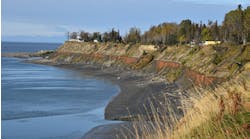
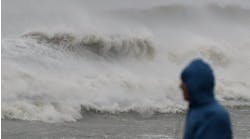
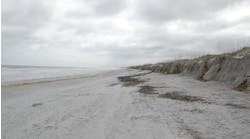
It’s not merely a change in sea level but also the effect that will have on storm surges and erosion patterns that will cause the problems, and the panel of speakers also discussed the merits of different approaches for combating those problems: massive flood control structures such as those that have been proposed for New York City (at a cost of $10 billion to $20 billion), hard armoring such as sea walls, beach renourishment, and finally managed retreat from coastal areas—either passively, by not rebuilding what is lost, or actively, by buying up the land and structures in vulnerable areas. All of these cost money, and part of the discussion is what to protect: What do we as a society value? What is most critical? What can we let go?
Questions like these will be explored at the Coastal Protection Symposium, taking place next August concurrently with the StormCon conference in Myrtle Beach, South Carolina. If you are involved in coastal flood protection or planning, consider submitting an abstract. You can find details at www.StormCon.com. The deadline is December 5.
StormCon Call for Papers Is Open
StormCon, the North American Surface Water Quality Conference and Exposition, is now seeking abstracts for presentations at StormCon 2013. The conference will take place August 18 – 22, 2013, in Myrtle Beach, South Carolina. Presentations are 30 minutes each. Abstracts are due December 5, 2012.
We are seeking abstracts in six conference tracks plus the Coastal Protection Symposium. The six conference tracks are:
* BMP Case Studies
* Green Infrastructure
* Stormwater Program Management
* Erosion and Sediment Control
* Water-Quality Monitoring
* Advanced Research Topics
The Coastal Protection Symposium takes place concurrently with StormCon and focuses on infrastructure protection in coastal cities in the face of sea level rise and potential shoreline changes.
More information on the conference and the individual tracks is available at www.StormCon.com, along with an online abstract submittal form.